Grand Rapids, MI · Garage Door Service
Serving Ridgemoor, 4 miles SE of Grand Rapids, with garage door repair suited to homes built in the 1954-2002 stock and Michigan's cold winters.
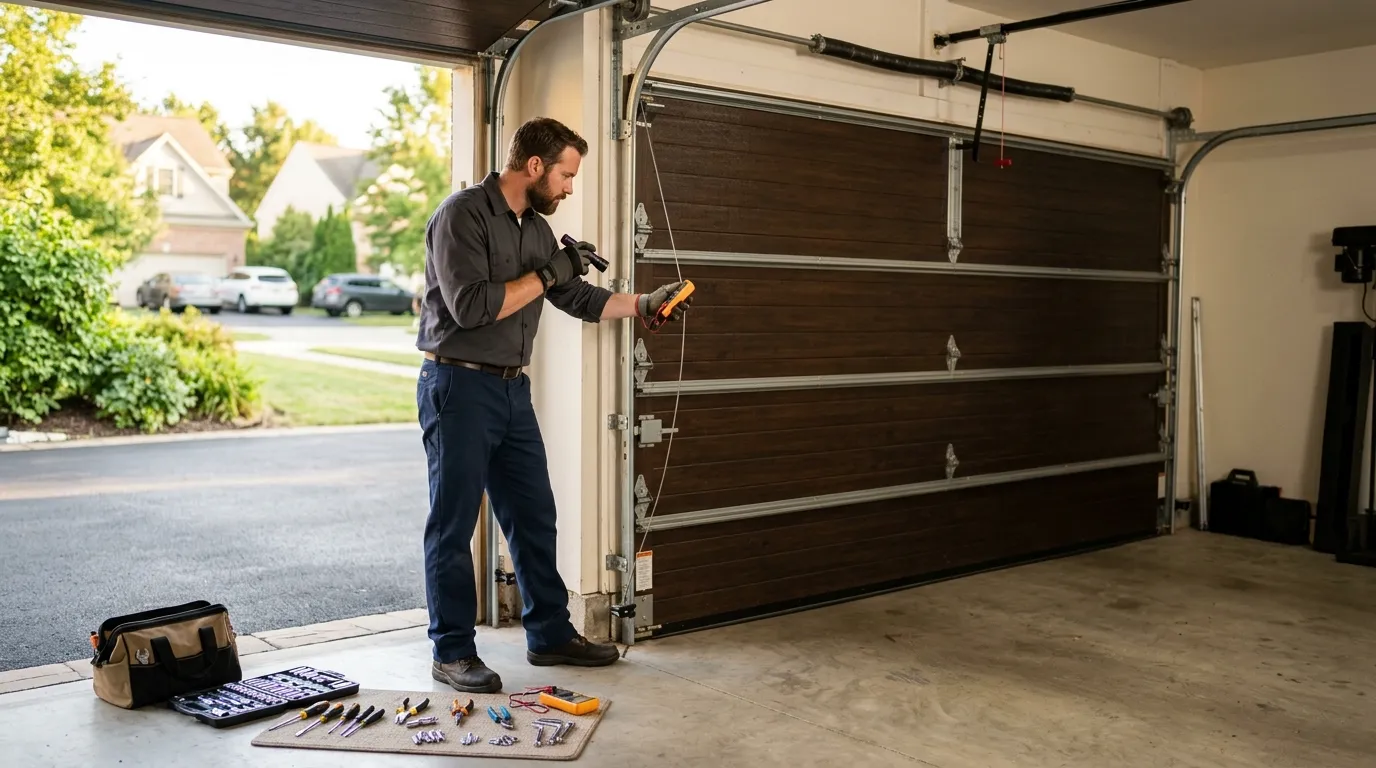
Ridgemoor sits about 4 miles southeast of downtown Grand Rapids, inside a wider service area where housing generally went up between 1954 and 2002, with the median build year landing around 1983. That puts most garages in this pocket at somewhere between a 20 and 40-year-old door and opener, depending on the block. A door from the 1980s or 90s usually means steel panels on galvanized track, a chain-drive opener that's had at least one motor or gear-and-sprocket replacement by now, and torsion springs that were sized for the original door weight - not always what's hanging on the hinges today if a panel got swapped or insulation got added later.
We don't have street-level records for Ridgemoor specifically, so we're not going to pretend we know which block has which door. What we do know is the era, and the era tells us most of what we need before we ever pull up: original hardware nearing the end of its cycle count, openers that predate rolling-code safety standards, and springs rated for a lighter, uninsulated door than what often replaced it.
Given the 1954-2002 build window, expect a mix of single-piece and sectional steel doors, most on extension or torsion spring setups depending on when the garage itself was added or updated. Homes from the earlier end of that range sometimes still run older extension-spring systems without safety cables - a real hazard if a spring lets go while the door's open. Anything closer to the 1983 median is more likely sectional, torsion-sprung, with an opener that's been replaced once or twice since install.
Michigan's cold-and-severe climate band matters here too. Repeated freeze-thaw cycles work on weatherstripping, bottom seals, and track alignment every winter, and openers with older limit switches can struggle when a door's frozen slightly to the slab. We see a fair number of calls that turn out to be ice or a stuck seal, not a broken part - worth checking before you assume the worst.
One limitation worth saying plainly: if a door is original from the low end of that build range and the drum or torsion tube is worn past spec, we're not going to rebuild it piece by piece just to keep it running. At that point full replacement is usually the honest recommendation, not another patch repair.
We work across the Grand Rapids service area, and Ridgemoor is a short run from downtown - about 4 miles southeast. When you call, the more you can tell us about the door's age and how it's acting (won't close all the way, opener runs but door doesn't move, loud bang followed by the door not budging), the better we can guess what's in the truck before we knock on the door.
We don't have a posted response-time guarantee to quote you, so we won't invent one. What we can tell you is that jobs in this part of the city are routine for us - the housing stock here isn't unusual, just consistent, and that consistency is what lets us carry the right springs and rollers without guessing.
Ridgemoor sits roughly 4 miles southeast of downtown Grand Rapids. It's part of a broader service footprint that runs from close-in neighborhoods like Garfield Park and Reeds Lake out to farther towns such as Caledonia, Ada, and Cutlerville. Across that whole area, the numbers are consistent: about 151,171 households and 75,312 owner-occupied houses, with median household income around $76,463 - the kind of homeowner base that tends to keep a door running rather than let it sit broken, but also isn't rushing to replace a working door early.
We mention the wider area because Ridgemoor isn't served in isolation - the same trucks, the same stock of springs and rollers, and the same read on what a 1980s-era garage needs cover both the neighborhood and its neighbors. If you're on the edge of Ridgemoor near Reeds Lake or Shawnee Park, the same holds true.
We don't have street-by-street records for Ridgemoor, but the broader area's housing stock runs 1954 to 2002 with a median around 1983. That puts most original doors and openers somewhere in the 20-to-40-year range, which is often past the point where parts are easy to source.
No. We don't have that level of detail and won't guess at it. What we can go on is the housing era for the area, which tells us a lot about spring type and opener age without needing an exact address history.
Yes, more often than owners expect. Michigan's cold winters put real strain on weatherstripping, bottom seals, and track alignment, and a door that seems broken is sometimes just frozen to the slab or fighting a stiff seal. Worth checking before assuming a part failed.
Depends on what's worn. If the torsion tube or drum is past spec on an original door from the early end of the 1954-2002 range, we'll usually tell you replacement is the better call rather than another patch. We won't rebuild a door just to keep billing you for repairs.
Call now or request a free quote - same-day service on most repairs, upfront written pricing.