Grand Rapids, MI · Garage Door Service
Wyoming's homes skew older than the Grand Rapids average - median build year 1969. That means different hardware, different failure points, and a maintenance visit worth doing right.
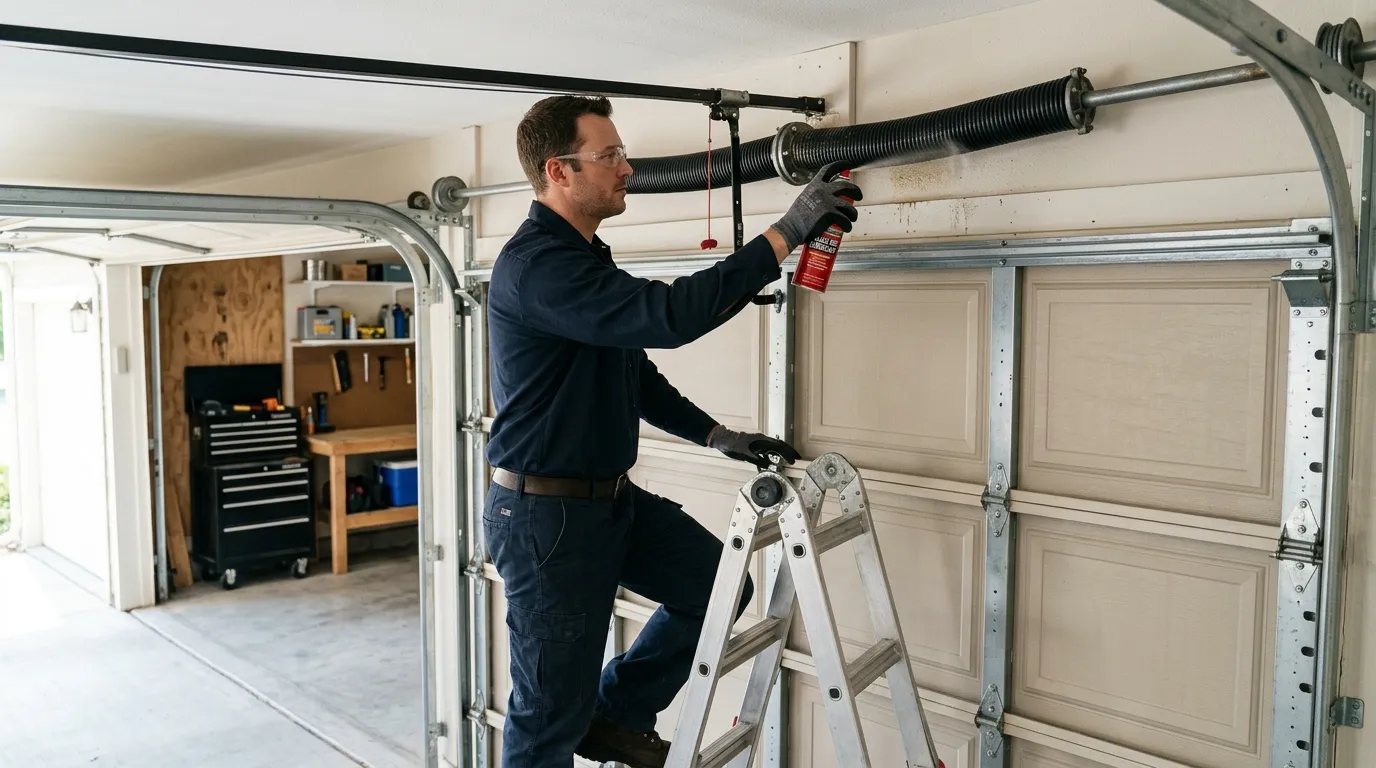
Wyoming's median home dates to 1969, a good bit ahead of the 1983 median across the wider Grand Rapids service area. That gap matters for maintenance, not just curb appeal. A door and opener installed or replaced during a 1970s remodel is more likely to be running on hardware nobody has serviced in years, and some of what a homeowner can check safely is limited by how that hardware ages.
You can do a few things yourself without tools beyond a stepladder and a rag. Wipe down the tracks and look for rust or flaking on the rollers. Check that the rubber weather seal at the bottom of the door still sits flat against the slab - on a house this age it's often been replaced once or twice already, and a gap lets cold air and road salt spray in. Test the auto-reverse safety feature by setting a piece of wood on the floor under the door and closing it; the door should reverse on contact.
What you shouldn't do yourself: touch a torsion spring, adjust cable tension, or take apart an opener's motor housing. Springs on doors this age are under real load and the failure mode is not gentle. If a spring looks stretched, rusted, or has a visible gap in a coil, that's a call, not a DIY project.
We don't publish a flat maintenance price here because the job depends on what's on the door - torsion vs extension springs, steel vs older wood-composite panels, belt vs chain opener. What we can tell you is that Wyoming sits inside a service area where median household income runs $76,463, and Wyoming's own figure is a bit lower at $72,163. That's not a coupon pitch - it's context for why a lot of owners here choose an annual tune-up over waiting for a breakdown call, since a caught problem is almost always cheaper than an emergency one.
Across the roughly 151,171 households we cover, about half own rather than rent, and owner-occupied houses are the ones that tend to book routine maintenance - renters generally aren't the ones calling. If you're weighing a maintenance visit against just waiting, ask yourself how old your spring set is and how the door sounds when it travels. Grinding, shuddering, or a visible sag on one side usually means the visit pays for itself the first time it prevents a Saturday morning spring failure.
Michigan's winter climate sits in the severe-cold band, and that's the biggest single driver of maintenance calls we see on houses built in Wyoming's era. Cold makes steel brittle and grease stiff. A torsion spring that's fine in August can snap in January because the metal has less give and the door is working harder against a track that's contracted slightly in the cold.
Houses from the 1969 build era around here often still run original or first-generation replacement track hardware - narrower rail, smaller rollers - that wasn't built with today's insulated doors in mind. When a heavier replacement panel goes on old track, the opener has to pull harder than it was ever sized for, and that shows up as a strained motor or a chain that jumps.
Salt and slush thrown up from the driveway during the winter months corrode the bottom bracket and cable ends faster than most owners expect. On a maintenance visit we're looking at that hardware specifically, not just listening for noise.
The complication we run into most in Wyoming is mismatched replacement parts. A door from 1969 that's had one or two partial upgrades over 50-plus years sometimes has a spring rated for a panel weight the house no longer has, or a track spliced from two different eras. Matching new hardware to old brackets isn't always a straight swap, and sometimes the honest answer is that a repair isn't worth it - a heavily patched door on tired track is often cheaper to replace outright than to keep maintaining piecemeal.
We travel to Wyoming from our Grand Rapids base, about 6 miles out, so we're not doing same-day drop-in checks the way a shop physically in town might. Scheduling a maintenance visit ahead of the cold months, rather than calling once a spring has already let go, gives us room to bring the right parts on the truck the first time instead of a return trip.
Once a year is the general rule, ideally in fall before the severe cold sets in, since Michigan's winter is what stresses steel springs and track hardware the most. If your door is on original 1970s-era hardware, an annual check catches corrosion and spring fatigue before it turns into a January breakdown.
It depends on what's failed. A worn spring, roller set, or seal is almost always worth fixing. If the track is spliced from multiple eras or the panel has been patched more than once, replacement often ends up cheaper than continuing to maintain a door that's fighting mismatched parts.
No - we're based in Grand Rapids and travel to Wyoming, about 6 miles away, for maintenance and repair calls. We don't operate a separate branch or depot in town.
Cold stiffens the grease in the opener and the metal in the springs and track, so the motor works harder to move the same door. On houses with older, narrower track from the 1969-era building stock, that extra strain shows up faster than on newer hardware.
Call now or request a free quote - same-day service on most repairs, upfront written pricing.