Grand Rapids, MI · Garage Door Service
Grandville homes average a 1977 build year, so original track hardware bends, rusts, or slips loose - here's what causes off-track doors and how to fix them.
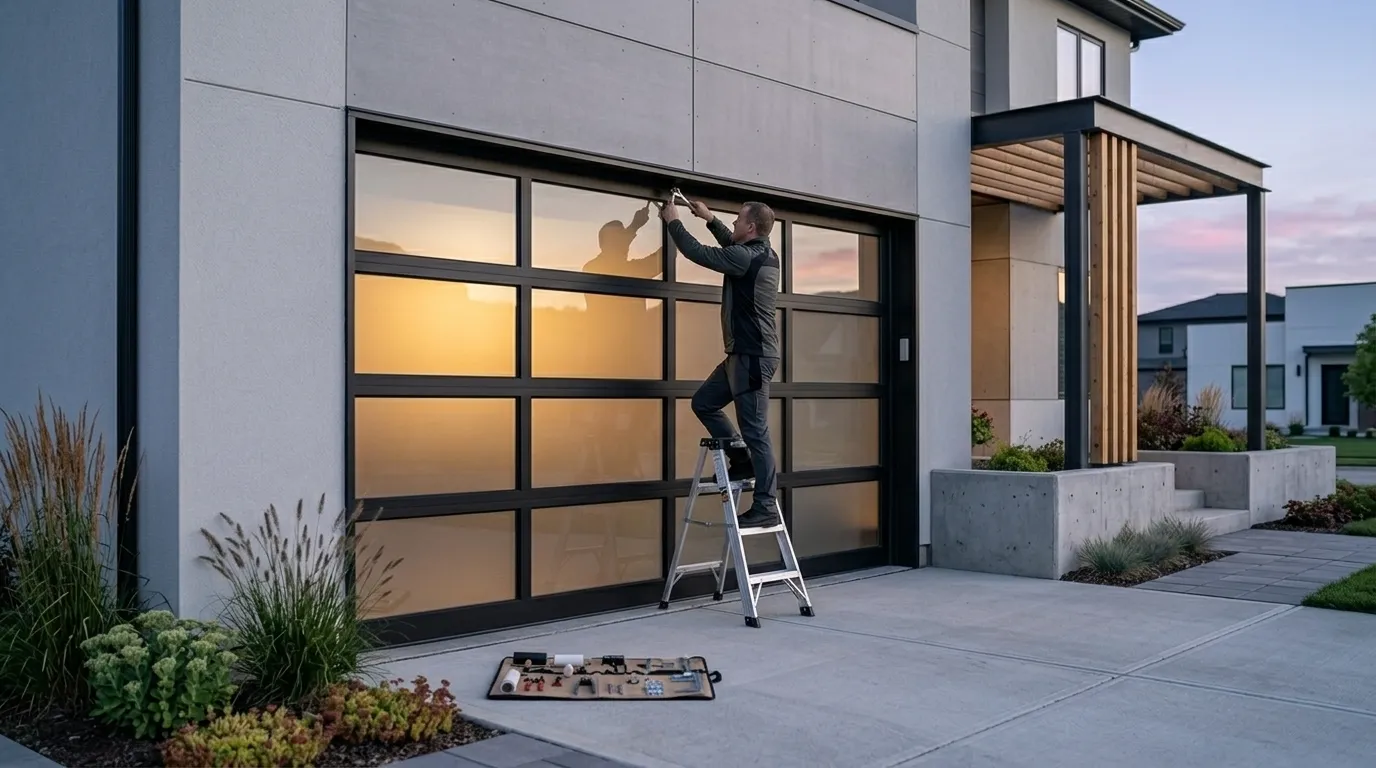
Start with the money, because it decides the call. Grandville's median household income sits at $78,551, a little above the wider Grand Rapids service area's $76,463. At that income, most owners here still land on the repair side of the repair-or-replace line for a track problem - a bent section or a worn roller is a parts-and-labor job, not a door replacement, unless the panel itself is dented or the opener is failing too.
Why this shows up so often here: Grandville's housing stock centers on a median build year of 1977, a bit earlier than the broader service area's 1954-2002 span with its 1983 median. Doors from the late '70s and early '80s were hung on lighter steel track with fewer adjustment points than what goes in today. Forty-plus years of seasonal temperature swings work the mounting brackets loose, and the track edges start to bow inward or outward. Add a car bumper clipping the bottom bracket, or a broken roller riding sideways instead of straight, and the panel walks right off the rail.
Cold winters compound it - the region's climate is classed as severe cold, and metal track contracts hard in a deep freeze, which is exactly when a marginal bracket finally lets go.
A straightforward off-track fix - re-seating the panel, tightening or replacing a bracket, swapping a worn roller - is usually a single-visit repair once the truck is on site. Where it stretches out is diagnosis: on a 1977-era door, the track gauge and bracket spacing don't always match what's sold today, so we sometimes spend time confirming what will actually bolt up before we touch the door.
We're not a Grandville-based shop - the truck comes from Grand Rapids, about six miles out - so travel is part of the timeline, not the repair itself. Once we're there, the job itself doesn't take longer because of the distance; it takes longer because of what's inside the wall. A door that's been off-track and forced back on by hand, more than once, usually has stripped screw holes or a track that's permanently kinked, and that adds a step we can't skip.
Off-track sounds simple until you open the garage and find the real problem underneath it. On houses built in the late '70s and '80s, the complication we see most is a door that's been pushed back onto the track by the homeowner or a previous handyman, which stretches the track holes and leaves the bracket unable to hold alignment even after a clean repair.
The second complication is spring tension. A torsion spring under load turns a simple off-track panel into something that can slam or snap back if the track is opened wrong. We don't treat those as the same job - a door under tension gets the spring addressed first, track second.
The third complication is cable wear. Original cables from a 1977-era install have had four-plus decades of cold-weather contraction and expansion. A cable that's frayed near the drum can look fine until it's the reason the door came off one side and not the other. We check cable condition anytime we're already in the track.
The door usually gives warning before it fully derails. Watch for a panel that rides higher on one side than the other as it closes, a scraping or grinding sound near one roller, or a visible gap where the wheel has jumped the rail. Sometimes the door stops mid-travel and won't go up or down at all - that's often the opener sensing resistance from a panel that's already partly off.
On older Grandville houses, we also see a slower version: the door closes unevenly for weeks, a little worse each time, as a loosening bracket lets the track edge drift wider. By the time it fully jumps the rail, the bracket holes are usually too worn to just re-tighten - which is why catching the uneven-close symptom early saves a bracket replacement, not just a service call.
For track repairs we carry standard steel track sections, replacement rollers (nylon and steel), track brackets, and lift cables in common gauges. Most single off-track jobs use parts we already have on the truck.
Where we sometimes have to order in: brackets or track sections sized to match older, narrower rail systems still found on some 1970s and early-1980s doors in this area. We won't force a modern-width bracket onto an old track just to avoid a return trip - a mismatched fit is how the same failure happens again in a year.
If the door is simply resting off one roller and there's no tension on the springs, some owners can carefully guide it back onto the track by hand - but that's the limit of what's safe to do without training. If the door won't move, is stuck at an angle, or the springs are visibly wound, don't force it. A torsion spring holding a door under load can release with enough force to break a bone or worse, and there's no way to tell from outside the garage how much tension is left in a spring that's already fighting a jammed track.
Honest limitation: we don't do cosmetic touch-ups on a door frame or track once it's structurally sound - if the fix works but the paint's scratched, that's not a callback item for us. Our job is the mechanism, not the finish.
Most of the houses here were built around 1977, and the original steel track and brackets have had over four decades of cold-weather contraction and expansion. Combined with a bumped bracket or a worn roller, that loosened hardware lets the panel walk off the rail. It's a hardware-age problem more than a one-time accident, usually.
At Grandville's median household income of $78,551, a bent track or worn roller almost always makes sense to repair rather than replace - it's a parts-and-labor job. Replacement only becomes the better call if the panel is dented, the opener's failing too, or the track has been forced back into place repeatedly and the bracket holes are stripped.
We run out of Grand Rapids, about six miles from Grandville. There's no local branch here - the truck comes from Grand Rapids for every call in this area.
Only if there's no spring tension and the door is just resting off one roller - even then, go slow. If the springs are wound or the door won't budge, stop and call. A loaded torsion spring on a stuck track can release with enough force to cause serious injury, and you can't judge remaining tension from outside the garage.
Call now or request a free quote - same-day service on most repairs, upfront written pricing.