Grand Rapids, MI · Garage Door Service
Grandville homes mostly went up around 1977, earlier than the area median. We service the steel doors and spring hardware that came with that era, from our Grand Rapids shop.
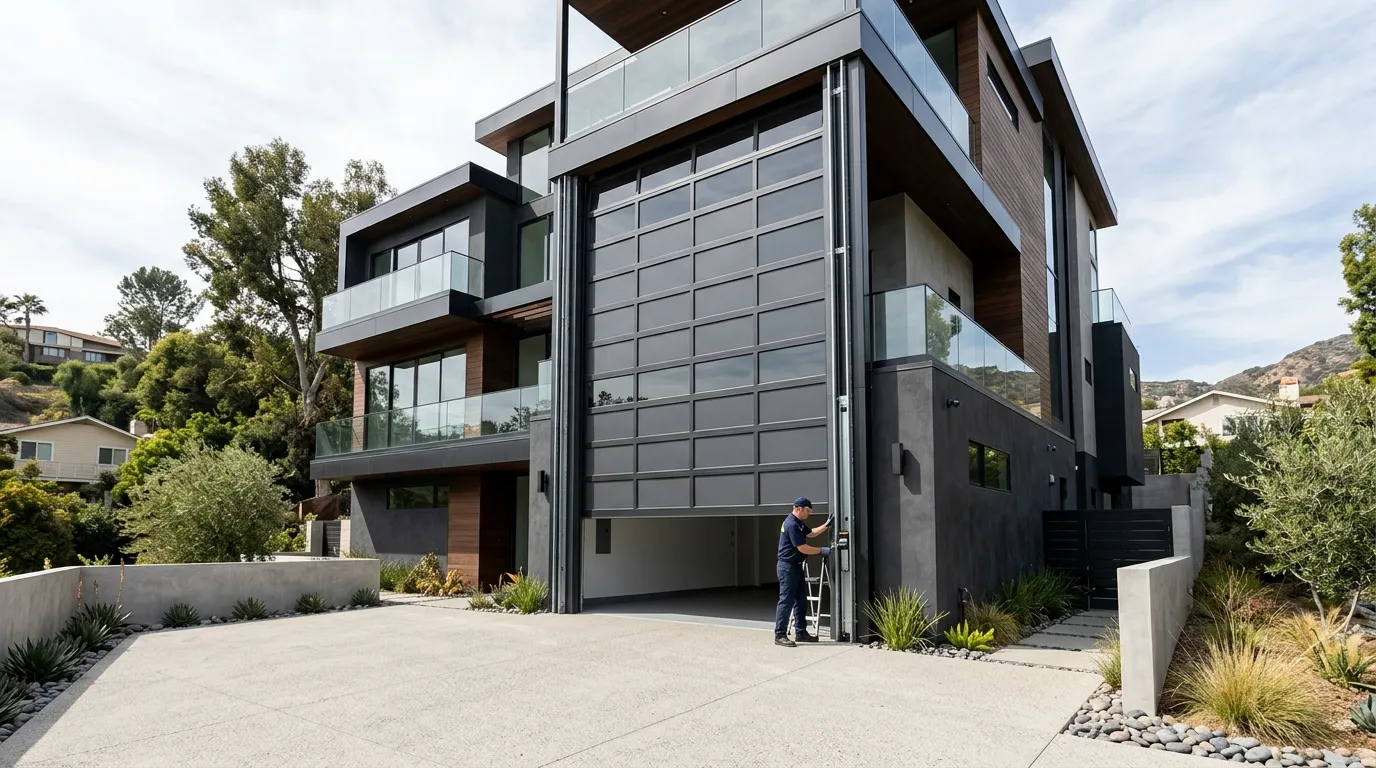
Start with what's actually hanging in the opening. Grandville's housing stock centers on 1977, a few years ahead of the wider service area's 1983 median, which means a lot of these garages still carry the door that came with the house: single-layer steel, no insulation, either a 9x7 single or a 16x7 double depending on the builder, hung on extension springs more often than the torsion setups that became standard in newer construction. That door was built for a different set of expectations than what owners want out of a garage door today.
Age alone doesn't break a door, but it sets up everything that does. Steel that thin, left uninsulated, expands and contracts with every cold front, and the hardware bolted to it - end bearing plates, hinges, the track brackets fastened straight into original framing - has been doing that for close to fifty years. Rollers wear oval instead of round. Hinges stretch their holes. None of this is dramatic until the day it is, usually when a spring finally lets go and the door drops on whatever's underneath it.
We're not guessing at this from a spreadsheet. It's the pattern we see truck after truck in this part of the county: the fault follows the build year, not the brand.
A spring replacement on one of these older single-layer doors is a same-day job once we're on site - the work itself doesn't take long, the springs are a standard size for that era and we carry them on the truck. Where the time actually goes is diagnosis: on a house this old, a broken spring is sometimes the second problem, not the first. If a bearing plate has been dragging metal-on-metal for a year before the spring finally snapped, that's a separate conversation.
Opener swaps run longer, closer to half a day, mostly because the original wiring and the wall control from a 1970s install rarely match anything a current opener expects. Panel replacement depends entirely on whether we can match the existing door - steel doors from this period aren't always a stock size anymore, and if we have to order a full replacement panel or a whole new door, that's not a same-visit fix.
We travel to Grandville from Grand Rapids, about 6 miles out, so we're not promising a walk-in response - we're honest that it's a scheduled truck run, not a branch around the corner.
The complication with houses from this era is usually behind the door, not on it. Framing built in 1977 wasn't engineered around today's heavier insulated doors or the openers that lift them, so when an owner upgrades from the original steel door to something newer and heavier, the jambs and header sometimes need reinforcing before the new hardware goes in - otherwise the track pulls loose within a year.
Cold makes the rest worse. This service area sits in a severe cold climate band, and a fifty-year-old extension spring set behaves differently in January than it did when it was installed. Steel contracts, lubrication thickens, and a spring that's been marginal all fall tends to go in the first hard freeze. We see more of these calls out of Grandville's older stock than out of the newer suburbs simply because there are more original springs still in service here.
The honest limitation: if the header's rotted or the framing's shifted, that's carpentry work outside what a garage door call covers, and we'll tell you that up front rather than force hardware onto wood that can't hold it.
Most calls from this part of town start the same way: the door won't open, or it opens a few inches and stops, or it comes down faster than it should and drops the last foot instead of settling. On a house this age, that's almost always a spring - either it's snapped clean (you'll hear it, a bang loud enough to bring you outside) or it's stretched out and lost tension gradually, which shows up as the opener straining and the door sagging on one side.
A second common symptom is noise - a grinding or popping from the track as rollers worn from decades of use bind instead of rolling. That one doesn't fail all at once; it gets louder over months until someone finally calls.
Less common, but it happens on original installs: the cable frays where it wraps the drum, and the door starts running crooked before it jams outright. None of these are emergencies in the sense of danger to the house, but a door stuck open is a security problem and a door stuck shut is worse if it's the only way into an attached garage.
For doors built in this window, we stock extension and torsion springs sized to the 9x7 and 16x7 openings that were standard through the 1970s and 80s, along with the end bearing plates and center brackets that wear out on original hardware. We also carry rollers in both nylon and steel, since a lot of these garages still run the original steel rollers that are noisy but not yet broken, and swapping them out is often the cheapest fix on the truck.
Opener parts are more limited - if the unit itself is original to the house, we can usually get a replacement opener on the truck same visit, but we don't stock circuit boards or logic modules for units that old, since most manufacturers stopped supporting them years ago. Cable, drums, and standard-width panels for steel doors are stocked; full custom-width doors or discontinued panel styles have to be special-ordered, and that's a lead-time job, not a same-day one.
Rollers, weatherstripping, and hinge tightening are reasonable DIY work if you're comfortable on a ladder - none of that involves stored tension. Springs are a different matter entirely. A wound extension or torsion spring on a door this size holds enough force to break bones or worse if it releases while you're working on it, and the tools to do it safely aren't the ones sitting in a kitchen drawer.
If your door is one of the original 1970s installs and the opener is straining, sagging, or making noise it didn't used to make, that's worth a call before you touch the springs yourself. The honest trade-off: on a door this old, sometimes the repair costs enough that replacing the whole unit with an insulated door makes more financial sense than fixing an original that was never built to modern spec. We'll tell you which side of that line you're on before we start.
Most of Grandville's housing went up around 1977, so a lot of garages still have their original steel door and spring hardware. Fifty years of expansion and contraction from cold winters wears out bearing plates, rollers, and springs faster than owners expect, and once one part goes, the others aren't far behind.
No. We're based in Grand Rapids and travel to Grandville, about 6 miles out, for scheduled service calls. We don't promise walk-in response times here since it's a truck run, not a storefront.
Sometimes. Standard steel panel sizes from the 1970s and 80s are usually in stock. If the door is a discontinued width or style, matching it requires a special order, which adds lead time beyond a same-visit repair.
Depends on the door's condition beyond the spring. If the panels, track, and hardware are otherwise sound, a spring swap is the cheaper fix. If the door's uninsulated original steel is already dented or rusting, replacing it outright often costs less over time than repeated repairs.
Call now or request a free quote - same-day service on most repairs, upfront written pricing.